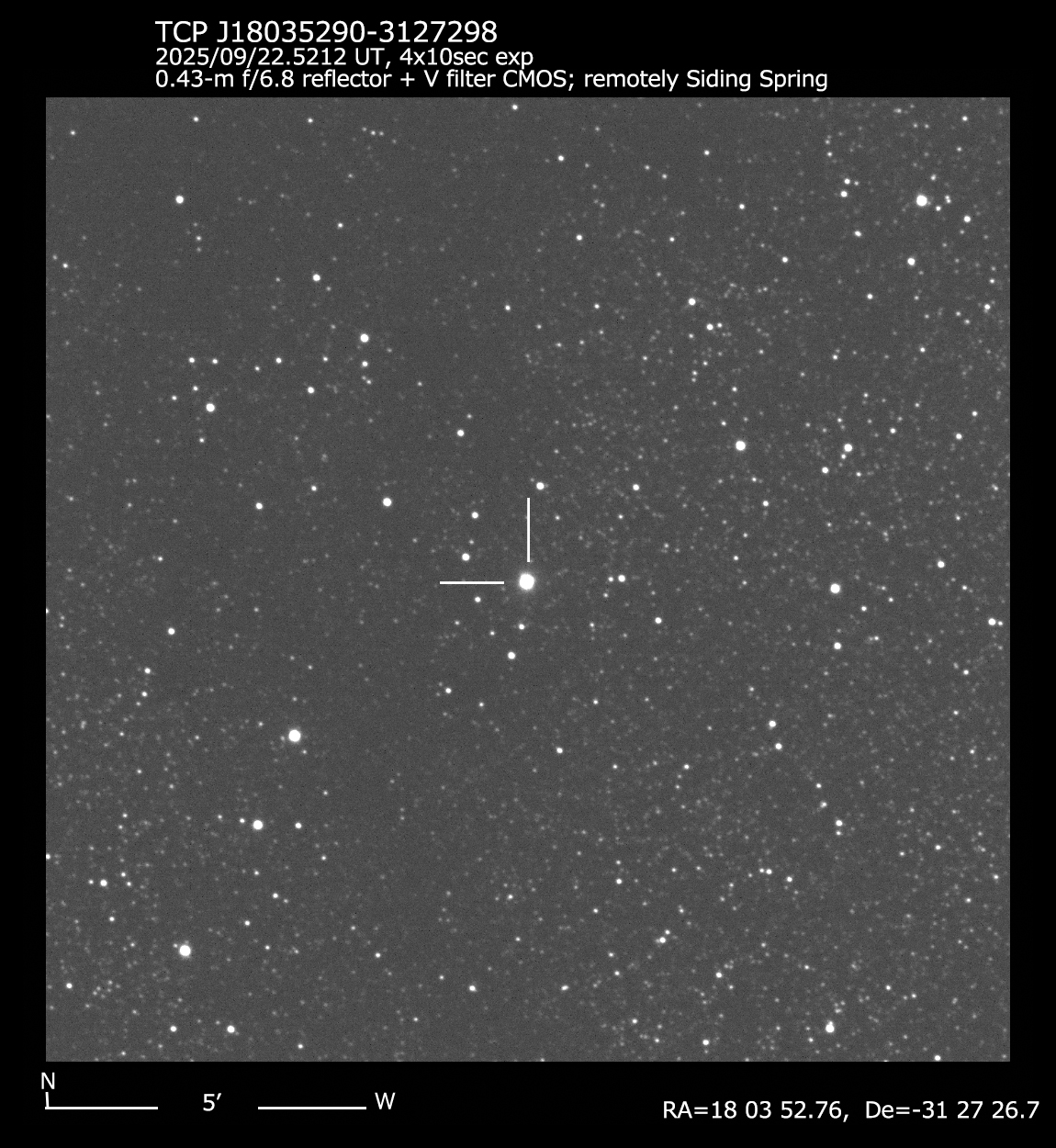
Abstract: V7994 Sgr (N Sgr 2025 No. 4 = TCP J18035290-3127298 = TCP J18035278-3127240) was independently discovered by three observers: John Seach (Grafton, NSW, Australia) at unfiltered magnitude 10.2 on DSLR images obtained on 2025 Sep. 21.381 UT; Tadashi Kojima (Tsumagoi, Gunma-ken, Japan) at unfiltered mag 10.5 on DSLR images obtained 2025 Sep. 21.420 UT; and Kazuyoshi Kanatsu (Shimane, Japan) at unfiltered magnitude about 10.6 on CMOS images obtained on 2025 Sep. 21.484 UT (report sent to CBAT by H. Yamaoka, National Astronomical
Observatory of Japan). SPECTROSCOPY: Spectroscopy by M. Fujii (Okayama, Japan) on Sep. 22.451 UT at the Fujii Kurosaki Observatory indicates the object to be a nova (via CBET 5612, report sent to CBAT by Kojima). SPECTRUM: Fujii’s spectrum of Sep. 22.451 UT at URL:
https://otobs.org/FBO/fko/n/tcp_j18035278-3127240/tcp_j18035278-3127240.htm. COORDINATES (J 2000): RA 18 03 52.76 Dec. -31 27 26.6 (VSX).
Justification: NEARBY STARS: Pearce notes that the variable is within 0.7" of Gaia DR3 4043865232860503296 (G mag 19.8). Seach reports nothing brighter than mag 12.7 within 1.3’ of the nova. (via CBET 5612). PHOTOMETRY: see Justification. LIGHT CURVE: View the light curve via the AAVSO Light Curve Generator (Enhanced LCG). IMAGES: K. Yoshimoto image obtained Sep. 22.521 UT at URL http://orange.zero.jp/k-yoshimoto/TCP_J18035290-3127298_20250922.jpg. The AAVSO requests coverage of this nova with observations of all types (visual, CCD/CMOS, DSLR, spectroscopy) and in all filters as it evolves. All novae are worthy of as good coverage as possible for as long as possible to support research on novae being carried out now and in the future. Spectroscopy is also encouraged where possible. See sections below for cadence and other observing recommendations. NOTES: Seach’s post to the IAU CBAT TOCP was assigned TCP J18035290-3127298; Kojima’s post was assigned TCP J18035278-3127240. E. Kazarovets (Inst. of Astronomy, Moscow) reports assignment of the GCVS name V7994 Sgr (via CBET 5612). PHOTOMETRY (selected from observations submitted to the AAVSO): Sep. 17.419, <13.5 DSLR (Kojima); Sep. 20.380, <11.0 unfiltered DSLR (Seach); Sep. 21.096, 11.2: (ASAS-SN, via Yamaoka); Sep. 22.376, 8.5 unfiltered DSLR (Seach); Sep. 22.480, 9.02 TB (A. Pearce, Nedlands, Western Australia); Sep. 22.480, 8.78 V (Pearce); Sep. 22.480, 8.43 TR (Pearce); Sep. 22.521, 8.58 V (K. Yoshimoto, Yamaguchi, Japan, remotely using iTelescope at Siding Spring, NSW, Australia); Sep. 22.521, 7.74 I (Yoshimoto); Sep. 22.949, 8.2 (A. Amorim, Florianopolis, Brazil, Tycho-2 catalogue star magnitudes via AAVSO Chart X40777KR); 22.5069, 8.7 (N. Brown, Yanchep, W. Australia); 22.6940, 8.53 CV +/-0.05 (K. Sokolovsky, Moscow, Russian Fed., NMW survey wide-field camera measurement); 22.7500, 8.1 TG +/-0.05 (V. Cseh, Debrecen, Hungary); 23.0750, 8.481 V +/-0.004 (J.-F. Hambsch, Mol, Belgium, remotely from Atacana, Chile); 23.0751, 8.429 V +/-0.005 (Hambsch); 23.0752, 7.257 I +/-0.005 (Hambsch); 23.0754, 7.246 I +/-0.005 (Hambsch); 23.0756, 9.014 B +/-0.003 (Hambsch); 23.0758, 8.978 B +/-0.003 (Hambsch); 23.6787, 7.72 CV +/-0.05 (Sokolovsky); 23.9400, 7.4 (J. Aguiar da Silva, Campinas, Brazil); 23.9708, 7.2 (Amorim); 24.1417, 7.408 TG +/-0.005 (A. Corkill, Riverside, CA); 24.5312, 6.9 (Brown); 24.7313, 6.4 CV DSLR (S. O’Meara, Maun, Botswana);