In Russian:
Blue Flares of Red Dwarfs
Earth & Universe, 2024, No5, pp. 76-85.
In theory, the SeeStar should be capable of undertaking photometry, but my own tests have not been very fruitful so far. This is mainly due to my lack of effort, but I have noticed a couple of things. Dropped frames are considerable— I hoped moving to an EQ-mounted device would help, but I’m still to confirm this. Secondly, my results have not been exceptionally stable for the little data I’ve processed, and I need to investigate it more. That being said, if the SeeStar can be made to work, that is very important as it would be a cost effective and simple entry point into photometry. So I encourage you to continue experimenting - as will I. Are you using your SeeStar in AZ or EQ mode? Are you running from the phone app or Seestar_alp?
1 Like
There is no doubt that the Seestar can perform photometry. I am running it on AZ mode, using both the phone app and the seestar_alp, dropped frames is an annoyance but not dramatic, there is of course noise and scatter as I am under Bortle 9 skies. Here is an example of a (partial) curve for an eclipsing binary:

2 Likes
Thanks for posting these results. As I mentioned, my lack of success is most likely associated with my lack of effort.
What sort of dropped frame rate are you getting in AZ mode? My initial trials in AZ indicated the dropped frame rate was higher than I would like, particularly at higher elevations where field rotation becomes a significant issue. Thus, I built an EQ mount from a broken Celestron fork.
Unfortunately, I could not get the Seestar to work satisfactorily in EQ with Seestar_alp for the longest time, but it did last week! I’m not sure whether this was associated with the new version of SeeStar_alp or some parameter changes I made, but that was encouraging. Of course, now we’ve got cloud so I’m waiting for clear skies to do what will hopefully be a series of successful runs.
In the ALT-AZ mode, I will typically get a 25-35% rejection rate for most objects I image. For mosaics, I will get 50-60% acceptable.
I typically stack in groups of multiples of 6 to improve my signal to noise.
The nice thing about using the SeeStar for photometry, is that I can leave it out all night using the PLAN mode, and image a bunch of stars/objects. I am under Bortle 6-7 skies. .
Scott
Hi, I am new to variable star photometry but have submitted a few observations using differential photometry with a CMOS camera on a 6 inch refractor. I have J-C filters but haven’t worked out transformations yet. This is a project I would be very interested in. At 30 second cadence how long ideally would you continue to monitor the star for on each observing night?
Ideally - from dusk till dawn, Mike 
Really - some hours near culmination, I suppose.
Parallel multicolor observations of selected target with other observer(s) are preferable.
Combined Spectroscopic and Photometric Analysis of Flares in the Dwarf M Star EV Lacertae

1 Like
Hi Mike,
We are ideally looking for long, time-series measurements, as this gives you the best chance of capturing a flare. So the best scenario is to capture all night while the target is above 30 degrees elevation. Obviously, not everyone can/wants to do this as they have other projects for which they are doing measurements.
Best regards,
Gary
2 Likes
Gary
My telescope is housed in an observatory in Utah and I am prepared to report long time series observations in either B or V. I’ve read somewhere that some degree of regional coordination was being implemented to balance the quantities of B and V reports. Is there a preference for B or V observations in the region I mentioned above?
Cheers,
Gary
Hi Gary,
Measurements in V-band would be ideal. We have several folks covering B-band. Another thing you might consider is VVVVVVVVB or something similar.
Best regards,
Gary
Thanks Gary. I’ve already reported 3 Time-series in B. Will shift to V when the Target and Moon get further apart.
With the mixed series approach, you’d then want my Obs as VVVVVVB?
Hi Everyone,
After discussion with Dr. Hawkins, the campaign was revised to request spectra be submitted to AVSpec (the AAVSO Spectroscopic Database) only when they show significant flare activity - before/during/after the flare.
Many thanks, and good observing,
Elizabeth Waagen, AAVSO HQ
1 Like
Near EB KM UMa there is comparely bright active BY Dra-type dwarf V346 UMa, which shows flares sometime.


Long duration of UV stars monitoring may help to improve eclipsing binaries TOMs and O-Cs. For example, here are pair of comparely bright neighbours (within 20 arcmin field):
UV ASASSN-17ra and EA ASASSN-V J235747.44+382910.0
UV YZ CMi and EB ASAS J074540+0338.6
The pair of questions about UV V1513 Cyg.
- Is there a sence to upload lightcurves without flare, or better do not pollute database?
- VPhot does not show V1513 Cyg. I do not understand why, the star is correct 100%.
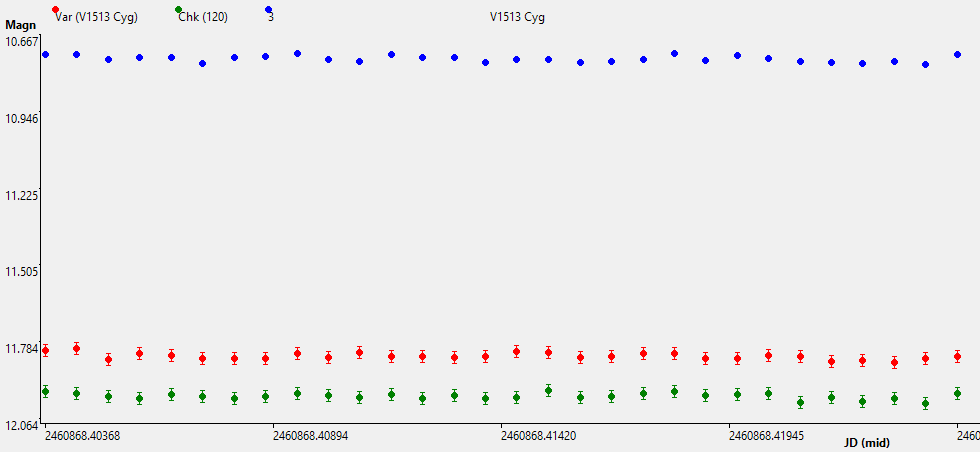
Understood, in a result of fast star motion neither VStar nor ASTAP does not find it on the image.
It is not so important due to absence of comp stars, but it will be no bad to correct position in the VSX.

If attempting to determine flare frequency rates, which are typically displayed in a Flare Frequency Diagram (FFD), it is essential to have all data. So, yes, if you are observing flare stars, please upload data for observation sessions with and without flares.
2 Likes
Also, my apologies for tardy responses to this forum. I monitor the Red Dwarf Group groups.io page on a daily basis, so I encourage anyone interested please join the group and concentrate your comments there.


A comment in VSX suggests this small eclipse is a known part of the lightcurve: “eclipse depth only 0.02 mag.” I presume the main features are from distorted shapes of the close binary + spottedness. Perhaps a third body involved?
\Brian